
Towards the end of some of my yoga classes, we spend a few minutes doing something that may not look very much like yoga at all.
I might ask you to touch each fingertip to your thumb in a particular order, make a different shape with each hand, remember a sequence or coordinate a movement with counting, rhythm or sound. It usually looks perfectly straightforward when I demonstrate it.
Then everyone tries it.
Suddenly, one hand has forgotten the instructions, the other has decided to copy it, and several perfectly capable adults are staring accusingly at their own fingers. Mine are not always any more cooperative. I can teach an exercise quite confidently and then discover that, as soon as I try to talk and demonstrate it at the same time, my hands have quietly abandoned the plan.
This is usually the point at which somebody asks why we are doing it.
I describe these activities as “brain yoga”, and you may have seen claims that repetitive hand movements, memory games or practices such as Sa Ta Na Ma can rewire the brain or even prevent dementia and Alzheimer’s disease.
The honest answer is more nuanced, and perhaps slightly less exciting than some of the claims you will find online.
There are good reasons to remain physically, mentally and socially active as we get older. There is also interesting research into activities that combine movement, concentration, memory, rhythm and coordination. What we cannot say is that ten minutes of finger exercises will prevent dementia.
Sadly, the brain is not quite that easy to outwit.
That is not why I include these activities in class. I use them because they offer an enjoyable and accessible way to practise attention, coordination, recall and learning. They ask the body and brain to work together in ways that are unfamiliar enough to make us concentrate properly rather than drifting onto thoughts about dinner, tomorrow’s jobs or whether we remembered to put the washing on.
They also offer an opportunity to notice how we respond when something does not come easily. Some people laugh. Some become fiercely determined. Some immediately announce that they have always been hopeless at this sort of thing. Quite a few start telling their fingers off.
The aim is not to perform the exercise perfectly. Nobody is being graded, and there is no certificate in advanced thumb tapping at the end of the class.
We are simply noticing, practising and trying again.
Brain health is bigger than any one exercise
When we think about keeping the brain healthy, puzzles such as Sudoku and crosswords often spring to mind. I enjoy a puzzle myself, but unfortunately one crossword a day does not give us immunity from everything else happening in our bodies and lives.
Healthy brain ageing is influenced by a much broader pattern of factors. The World Health Organization recommends regular physical activity as part of an approach that also includes managing blood pressure, diabetes, hearing health, smoking, alcohol use and other recognised risks.¹
The 2024 Lancet Commission identified 14 potentially modifiable factors associated with dementia risk across the course of our lives. These include physical inactivity, hearing loss, untreated vision loss, depression, social isolation, smoking, hypertension, diabetes and raised LDL cholesterol. The Commission estimated that addressing these factors could potentially prevent or delay around 45 per cent of dementia cases worldwide.²
That does not mean dementia is always preventable, or that people who develop it have somehow failed to look after themselves. Age, genetics, health inequalities and many other influences remain important.
It does mean that brain health is not determined by one clever exercise, one supplement or one perfect lifestyle.
It is shaped by how we move, learn, connect, rest and look after our wider health over time.
That may sound less appealing than being told that one particular activity holds the secret, but I find it more hopeful. It means there are many small ways in which we may support our wellbeing rather than one perfect thing we have to get right.
A good yoga class can contribute to some of this wider picture. Depending on the class and the person, it may include physical activity, balance, strength, breathing, coordination, focused attention, relaxation, learning and social connection.
- We move.
- We breathe.
- We pay attention.
- We learn.
- We laugh.
- We spend time with other people.
No, that does not mean yoga prevents dementia. It does mean that it can bring together several of the ingredients associated with healthy ageing.
That is a claim I am comfortable making.
What is happening when we learn something unfamiliar?
The word neuroplasticity often appears in conversations about yoga, movement and brain health. It is frequently described as the brain’s ability to “rewire itself”, which is memorable but can make the process sound more dramatic and instantaneous than it usually is.
Neuroplasticity refers to the brain’s ability to adapt in response to experience, learning, practice, injury and changing demands. This capacity continues throughout life.
Anyone who has learned to drive may remember how impossible it initially seemed to steer, change gear, check mirrors, watch the road and remember which pedal did what. With practice, much of it became more automatic.
The same general principle applies when we learn a movement sequence, although touching our fingers together in yoga class is clearly not equivalent to a full programme of cognitive training. Meaningful changes usually depend on repeated experience, and the effects relate to the particular thing being practised.
One muddled attempt at a finger sequence is therefore unlikely to transform your brain before you go home.
Equally, finding the exercise difficult does not mean you are bad at it or that anything is wrong. It usually means it is unfamiliar.
That distinction matters because we are often quick to judge ourselves when the body does not immediately follow an instruction. I see people begin an exercise with curiosity and, within seconds, decide that they “should” be able to do it.
My usual advice applies here too: try not to “should” on yourself.
Pause. Slow down. Work out which finger has gone rogue and begin again.
The learning is in the process, not in creating a flawless performance for the person sitting next to you.
Why do we use the hands?
Our hands are capable of an extraordinary range of precise movements. We use them to write, cook, dress, type, use tools, turn pages, stroke a pet and hold the hand of somebody we love.
Every one of these activities relies on a detailed conversation between the brain, the eyes, the sensory system and the muscles of the hand.
One of the best-known illustrations in neuroscience is the cortical homunculus, developed from the pioneering work of neurosurgeons Wilder Penfield and Edwin Boldrey in the 1930s.⁴
The word homunculus means “little person”, although the illustration looks unlike any person you would hope to meet in ordinary life. It has enormous hands, lips and tongue, with a comparatively small trunk and legs.
It is not a suggestion for a new yoga posture.
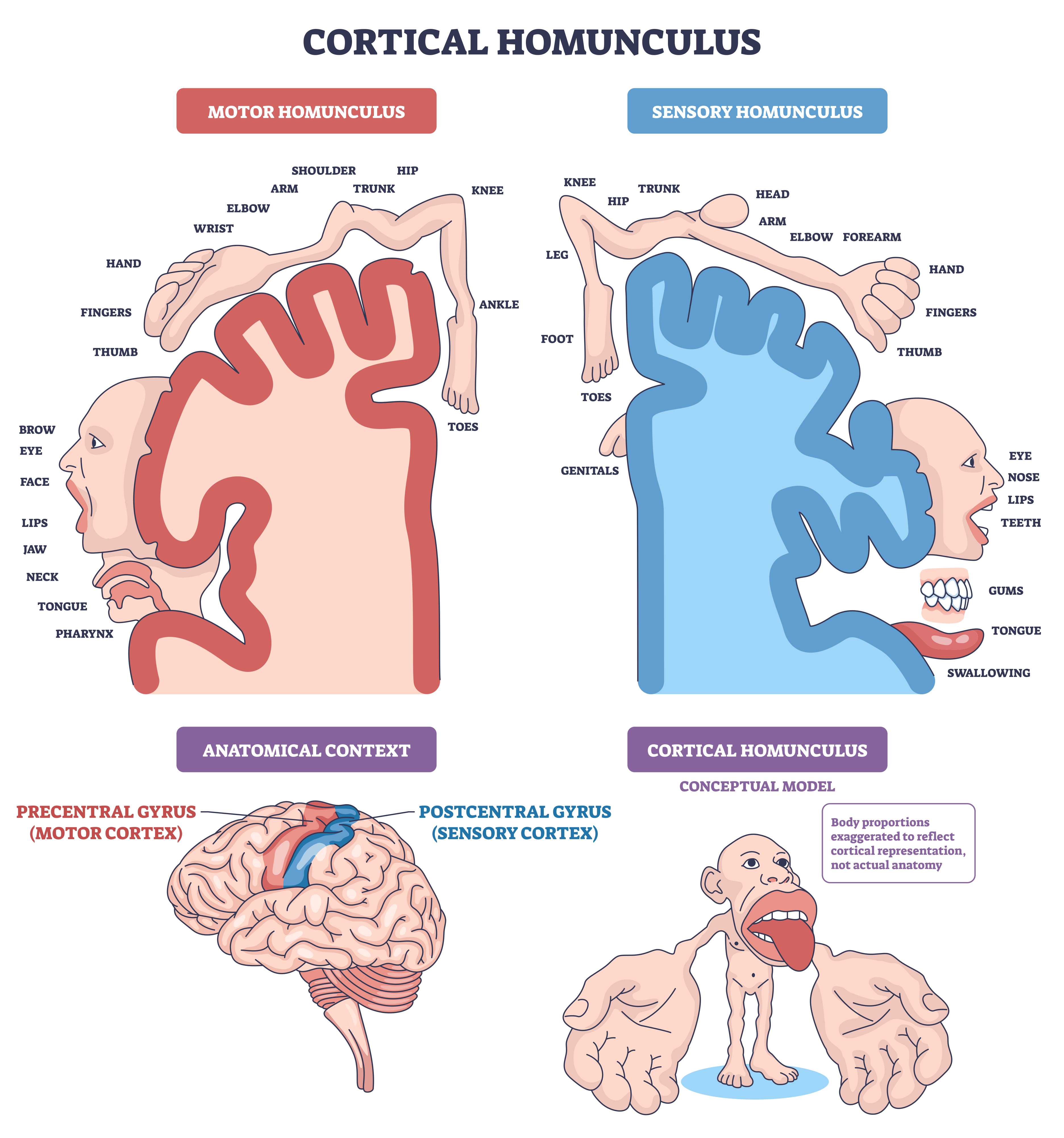
The illustration represents how much space different parts of the body occupy within areas of the brain involved in movement and sensation. The hands and mouth appear very large because they require particularly detailed control and receive a great deal of sensory information.
Modern neuroscience shows that the brain’s organisation is more complex and interconnected than this original illustration suggests, but the homunculus remains a useful way of understanding why a tiny finger movement can require a surprising amount of concentration.
Touching the thumb to each finger in the same order soon becomes familiar. Reverse the sequence, make each hand do something different, add a rhythm or ask people to count at the same time, and the whole arrangement can fall apart remarkably quickly.
There is often a brief moment when everyone looks at me as though I have personally rearranged their limbs.
These variations introduce novelty and attention. They may also involve what researchers call dual-tasking: carrying out a physical and cognitive task at the same time.
We do this constantly in everyday life. We walk while talking, cook while managing several timings, cross the road while watching traffic and listen to somebody while trying to remember why we entered the kitchen.
Research into structured programmes that combine physical and cognitive challenges suggests that they may improve some aspects of thinking, balance or walking in certain groups of older adults.⁵ The improvements are generally modest, and a research programme practised regularly over several weeks is not the same as spending a few minutes making shapes with our hands in a yoga class.
Even so, it helps explain why combining movement, memory and attention may be worth exploring.
Cross-body movements can create a similar challenge. We cross the centre line of the body whenever we fasten a seat belt, reach across a table or touch the opposite knee. Asking the two sides to perform different actions may require additional coordination and concentration.
You may hear that these movements “switch on both sides of the brain”. That is not a helpful description. Both hemispheres are already involved in most of what we do; one side is not sitting idle waiting for us to tap the opposite knee.
Cross-body activities can still be useful without needing a dramatic explanation. They practise coordination, attention and movement in a slightly unfamiliar form.
As always, more complicated does not automatically mean more beneficial. If an activity becomes so confusing that you are simply irritated, we can make it simpler.
Mild bewilderment can be entertaining. Complete exasperation is not a requirement.
Rhythm, memory and Sa Ta Na Ma
Rhythm can help to organise movement and memory. We use it naturally when walking, dancing, singing or clapping along with music. A steady beat gives the body and brain a structure within which to anticipate what comes next.
Anyone who can recall the words of a song from thirty years ago but has no idea why they walked upstairs will recognise that memory does not always behave in a straightforward way.
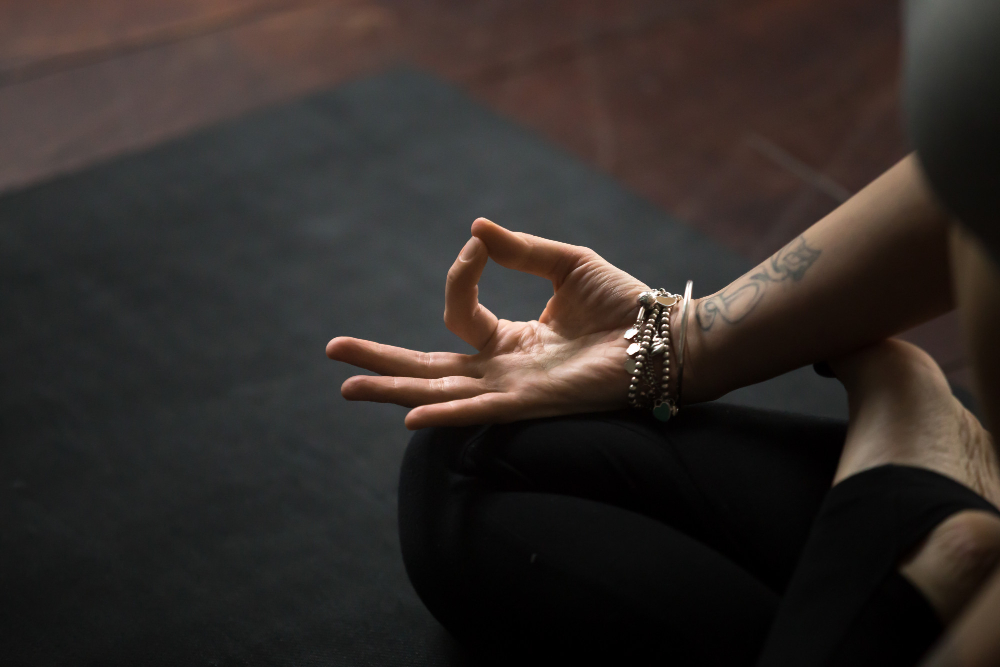
One rhythmic practice I sometimes introduce is known as Sa Ta Na Ma, or Kirtan Kriya. It combines four repeated sounds with a sequence of finger-to-thumb movements:
- Sa with the index finger
- Ta with the middle finger
- Na with the ring finger
- Ma with the little finger
The sequence may be spoken aloud, whispered and repeated silently before gradually returning to the spoken voice. Some traditional versions also include visualisation and a particular pattern of focused attention.
The practice comes from the Kundalini Yoga tradition. You will often read that the four sounds mean birth, life, death and rebirth. This is better understood as a symbolic teaching than as a literal translation of four separate Sanskrit words.
The sounds are associated with Sat Nam, commonly interpreted within the tradition as “truth is my identity” or “my true essence”. Sa Ta Na Ma represents a cycle of beginning, life, transformation and renewal.
You do not have to share a particular spiritual belief to take part. In my classes, it can be approached simply as a focused practice involving movement, rhythm, breathing, sound, memory and attention. You are also free not to chant. Yoga should offer choices rather than place people under pressure to participate in something that does not feel right for them.
Kirtan Kriya has attracted scientific interest because it brings together several activities within one brief practice. Researchers have studied versions practised for approximately 12 minutes a day over periods of eight or twelve weeks.
Small studies involving people with memory concerns have reported improvements in some cognitive tests and changes in measurements of blood flow in parts of the brain associated with attention and memory.⁶ Research involving family caregivers of people living with dementia has also reported improvements in mood and psychological wellbeing, alongside changes in patterns of gene expression associated with inflammation and immune function.⁷
These findings are interesting, but they need to be interpreted carefully.
The studies have generally involved relatively small numbers of people, different groups and short periods of follow-up. Some have examined Kirtan Kriya alone, while others have included it as part of a broader Kundalini Yoga programme. That makes it difficult to know which element, or combination of elements, may have contributed to the results.
Improvements in a memory test, a measure of mood or a brain scan do not demonstrate that a practice prevents Alzheimer’s disease.
A colourful image of the brain may make a wonderful headline, but it does not remove the need to examine the size, design and limitations of the study behind it.
The evidence therefore suggests that Kirtan Kriya may have potential benefits for attention, stress, mood and some aspects of cognitive function in particular groups. It does not show that finger movements or mantras prevent dementia.
Promising is not the same as proven.
I do not think that takes anything away from the practice. We can appreciate that something is engaging, calming or potentially helpful without requiring it to perform miracles.
I would rather make a modest claim I can stand behind than a dramatic one that falls apart when somebody looks at the research.
So why do I keep teaching these activities?
Because they bring together many of the things I value in yoga.
They encourage us to pay attention rather than operate entirely on autopilot. They invite us to learn something new, move in a different way and notice how we respond when things do not immediately go to plan.
That last part is often where the real practice begins.
I have watched people apologise because they “can’t do it”, even though half the room is equally confused. Others laugh until they cry because one finger simply refuses to join in. Some become wonderfully competitive with themselves, determined to master the sequence before I change it and make everyone start again.
None of those reactions is really about fingers.
They are about how we meet challenge.
- Do we become frustrated?
- Do we decide that we are hopeless?
- Do we compare ourselves with everybody else?
- Or can we slow down, breathe and approach the experience with curiosity rather than judgement?
Different people find different aspects difficult. Someone may remember sequences easily but struggle with rhythm. Another person may coordinate movement beautifully until words are added. Some manage everything perfectly until I start talking at the same time.
There is something rather reassuring about that.
It reminds us that being human is wonderfully untidy.
Enjoyment matters too. We are far more likely to continue with an activity that feels rewarding than one we dread. Walking with a friend is often easier to sustain than forcing ourselves through an exercise programme we dislike. Dancing may last longer than an exercise bike that becomes an expensive clothes horse.
If a few minutes of finger movements make people smile, concentrate, talk to one another and leave class feeling mentally refreshed, that has value in itself.
Not every benefit needs to be measured on a brain scan.
What if your hands do not cooperate?
These activities are adaptable.
The movement can be smaller or slower. You can use one hand instead of two. You can imagine the movement rather than carrying it out fully. You can rest, watch or choose not to take part.
There is no prize for pushing through pain.
If an exercise increases pain or leaves you becoming tense and frustrated, that is useful information. We can adapt it.
One advantage of finger and hand movements is that they can offer a way of exploring coordination and attention when larger physical movements are not available. This may be helpful for people living with arthritis, fatigue, persistent pain or restricted mobility.
As with everything else in yoga therapy, we work with the body available today rather than the body we think we should have.
A final thought
Looking after the brain is not about finding one magical exercise.
It is about the small things we do over time: moving regularly, learning, looking after our physical health, staying connected, resting, laughing and remaining curious.
The activities we practise in class are not intended to diagnose, treat or prevent disease. They are one small way of bringing movement, attention, coordination, memory and enjoyment together.
Sometimes the biggest lesson in yoga comes from a challenging balance.
Sometimes it comes from lying quietly in relaxation.
And sometimes it comes from discovering that your little finger has apparently resigned from the team.
If these few minutes encourage us to laugh, concentrate, learn something new and approach ourselves with a little more curiosity than criticism, I think they have already done something worthwhile.
Whether future research discovers additional benefits will be fascinating to see.
In the meantime, I will continue asking you to touch your thumb to your fingers, while quietly hoping mine remember what they are supposed to be doing too.
References
- World Health Organization. Risk Reduction of Cognitive Decline and Dementia: WHO Guidelines. Geneva: World Health Organization; 2019.
- Livingston G, Huntley J, Liu KY, et al. Dementia prevention, intervention, and care: 2024 report of the Lancet Standing Commission. The Lancet. 2024;404(10452):572–628. doi:10.1016/S0140-6736(24)01296-0.
- Stern Y. Cognitive reserve. The Lancet Neurology. 2009;8(10):1006–1012. doi:10.1016/S1474-4422(09)70016-6.
- Penfield W, Boldrey E. Somatic motor and sensory representation in the cerebral cortex of man. Brain. 1937;60(4):389–443. doi:10.1093/brain/60.4.389.
- Liao Y, et al. Effects of combined physical and cognitive training in older adults: a systematic review and meta-analysis. Ageing Research Reviews. 2022;81:101737. doi:10.1016/j.arr.2022.101737.
- Newberg AB, Wintering N, Khalsa DS, Roggenkamp H, Waldman MR. Meditation effects on cognitive function and cerebral blood flow in adults with memory complaints. Journal of Alzheimer’s Disease. 2010.
- Lavretsky H, Siddarth P, Nazarian N, et al. A randomised controlled trial of Kirtan Kriya meditation in family dementia caregivers: effects on mental health and gene expression. Translational Psychiatry. 2013.
Further reading
- World Health Organization: guidance on reducing the risk of cognitive decline and dementia
- Alzheimer’s Society: information on brain health and reducing dementia risk
- Alzheimer’s Research UK: evidence-based guidance on dementia risk
- The 2024 Lancet Commission on dementia prevention, intervention and care