
Keeping Your Cool: What Yoga Can (and Can't) Do During a UK Heatwave
The UK isn't built for prolonged periods of hot weather. Our homes are designed to keep warmth in rather than out, many of us don't have air conditioning, and temperatures that might feel comfortable elsewhere can quickly become exhausting here.
Some people seem to breeze through a heatwave, while others find it completely draining. Whether you're experiencing menopause, living with a long-term health condition, taking certain medications or simply don't cope well with the heat, you're certainly not alone. Even healthy bodies have to work much harder when temperatures rise.
People often ask me whether yoga can help keep you cool.
The honest answer is yes... and no.
Yoga won't lower the outside temperature or magically reduce your core body temperature. What it can do is help your body respond more efficiently to the heat, encourage you to use your energy more wisely, and help you feel calmer and more comfortable.
Perhaps most importantly, yoga teaches us to work with our bodies rather than against them.
Why hot weather feels so exhausting
Our bodies are remarkably good at maintaining a stable internal temperature. During hot weather they work much harder by:
- Increasing blood flow to the skin.
- Producing sweat so heat can evaporate away.
- Increasing heart rate.
- Using more energy simply to keep us cool.
That means your body is already working hard before you've even thought about exercising.
One of the most important lessons yoga teaches us is that there are times to challenge ourselves and times to conserve our energy.
A heatwave is usually one of those times.
Adapt your practice, don't abandon it
It's tempting to stop moving altogether when it's hot.
Unfortunately, that can leave joints feeling stiffer, muscles tighter and energy levels even lower.
Instead, think about changing how you move.
Swap vigorous flows or long strength sequences for:
- Gentle mobility
- Restorative yoga
- Yin yoga
- Supported stretches
- Breathing practices
- Yoga Nidra
As I often say in class, motion is lotion - but it doesn't have to be hard work.
Sometimes the kindest practice is simply lying on the floor with your legs supported on a chair, breathing slowly for ten minutes.
Can Sitali breathing really cool you down?
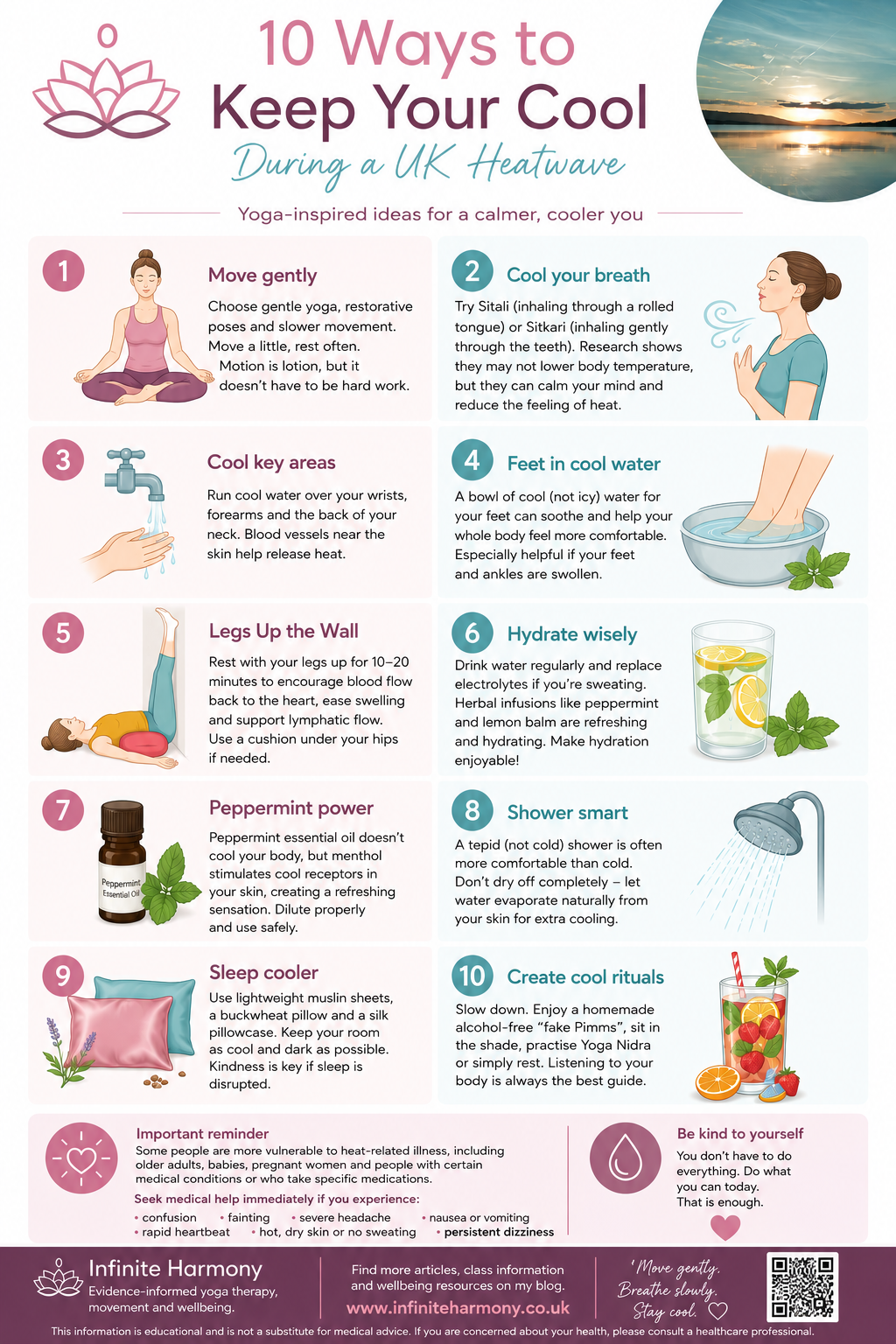
One of yoga's traditional cooling breathing techniques is Sitali Pranayama, where you inhale through a rolled tongue. If you can't roll your tongue, Sitkari Pranayama, where you inhale gently through the teeth, offers a similar alternative.
For centuries these practices have been described as cooling breaths.
Modern research paints a more nuanced picture.
Studies suggest that Sitali doesn't significantly reduce body temperature and may even slightly increase metabolic activity. However, many people still report feeling cooler afterwards.
Why?
Because cooling isn't only about temperature.
Slow, controlled breathing can:
- Reduce heart rate.
- Calm the nervous system.
- Ease feelings of stress.
- Change our perception of heat.
In other words, it may not literally make your body colder, but it can make the heat feel far more manageable.
Cool your body where it matters
Some of the simplest ideas are also supported by physiology.
Running cool water over your:
- Wrists
- Forearms
- Back of your neck
can improve thermal comfort because blood vessels lie close to the skin in these areas, allowing heat to transfer away more effectively.
A cool, damp flannel around the back of your neck while sitting quietly or practising Yoga Nidra can also feel wonderfully refreshing.
Don't forget your feet, either.
If you've ever paddled in the sea on a hot day, you'll know how quickly your whole body can begin to feel more comfortable.
A bowl of cool (not icy) water for your feet can be surprisingly soothing, particularly if your feet and ankles become swollen in warm weather.
Sometimes the simplest ideas really are the most effective.
Give your legs a helping hand
Heat causes our blood vessels to widen, which means fluid can collect more easily around the feet and ankles, especially if we've been standing or sitting for long periods.
One of my favourite restorative yoga poses during hot weather is Legs Up the Wall (Viparita Karani).
Resting with your legs elevated for 10–20 minutes may help:
- Encourage blood to return towards the heart.
- Reduce the feeling of heavy, tired legs.
- Ease mild swelling around the ankles.
- Support the natural movement of lymphatic fluid by changing body position.
- Provide a deeply restorative pause.
If getting your legs up a wall isn't comfortable, simply resting them on a sofa or placing your calves on a chair works beautifully too.
It's also the perfect position for practising slow breathing or enjoying a short Yoga Nidra.
Don't underestimate the humble tepid shower
Many people instinctively reach for an ice-cold shower but this is not always the most comfortable option.
A tepid shower is often better tolerated and avoids the sudden shock that very cold water can create.
One little trick I use is not drying myself completely afterwards but stand in front of a fan and allowing the water to evaporate naturally from the skin creates additional cooling as it dries.
Peppermint doesn't cool your body... but it can make you feel cooler
Peppermint essential oil is another favourite of mine during hot weather. It doesn't actually lower your skin temperature, however, the menthol stimulates cold receptors in the skin, creating a genuine sensation of coolness.
I occasionally use a safely diluted peppermint blend on my wrists or the back of my neck when I'm particularly warm.
Always dilute essential oils appropriately and avoid applying them to broken skin or close to your eyes.
Stay hydrated - and make it enjoyable
Hydration is one of the most important things we can do during hot weather.
Water is essential, but if you're sweating heavily, replacing electrolytes may also help maintain fluid balance.
I've found that adding electrolytes to my water encourages me to drink more simply because I enjoy the taste. Sometimes making hydration more appealing is half the battle. I don't like the sweet ones prefering the more natural flavour of Oshun.
Herbal drinks are another lovely option. Fresh peppermint and lemon balm make wonderfully refreshing additions to cold water, while one of my favourite summer treats is a homemade alcohol-free "fake Pimms". It has all the ritual and enjoyment of a summer drink without the dehydrating effects of alcohol.
Helping yourself sleep
Hot nights are often the hardest part of a heatwave.
A few things I've found helpful include:
- Lightweight muslin sheets or blankets.
- A buckwheat pillow, which allows more airflow than many foam pillows.
- A silk pillowcase that feels cool against the skin.
- A tepid shower before bed.
- Keeping curtains or blinds closed during the day to reduce heat build-up.
Sometimes it's also worth accepting that sleep may not be perfect during a heatwave.
Rather than becoming frustrated, treat yourself with a little kindness.
If you wake early, a short Yoga Nidra or breathing practice can often feel far more restorative than lying awake worrying about not sleeping.
Perhaps the greatest lesson yoga offers
Yoga isn't about pretending the heat isn't there.
It's about listening - to your body's signals, energy and to what today requires. Some days that might be a gentle stretch and other days it might be ten minutes of slow breathing.
Some days it might simply be sitting quietly in the shade with your feet in cool water, a refreshing herbal drink in hand, and giving yourself permission to rest.
This is responding wisely to what your body needs and exactly what yoga teachers us.
A final thought
If this heatwave has taught us anything, it's that wellbeing isn't about pushing through. It's about adapting.
Yoga reminds us that every day is different. Some days our practice helps us build strength and resilience. On other days, it's simply about slowing down, cooling off and giving ourselves permission to rest.
Sometimes the most therapeutic thing we can do is stop striving, listen to our bodies and respond with kindness.
After all, looking after yourself isn't a luxury - it's one of the best ways to keep yourself well.
References
- Telles S, et al. (2020). Physiological Effects of Sheetali and Sitkari Pranayama. International Journal of Yoga.
- Jerath R, et al. (2006). Physiology of Long Pranayamic Breathing. Medical Hypotheses.
- Haghayegh S, et al. (2019). Before-bed passive body heating by warm shower or bath to improve sleep: A systematic review and meta-analysis. Sleep Medicine Reviews.
- UK Health Security Agency. Beat the Heat: Staying Safe in Hot Weather.
- World Health Organization. Heat and Health.
- American College of Sports Medicine. Exercise and Fluid Replacement Position Stand.
- Tisserand R, Young R. Essential Oil Safety (2nd Edition).